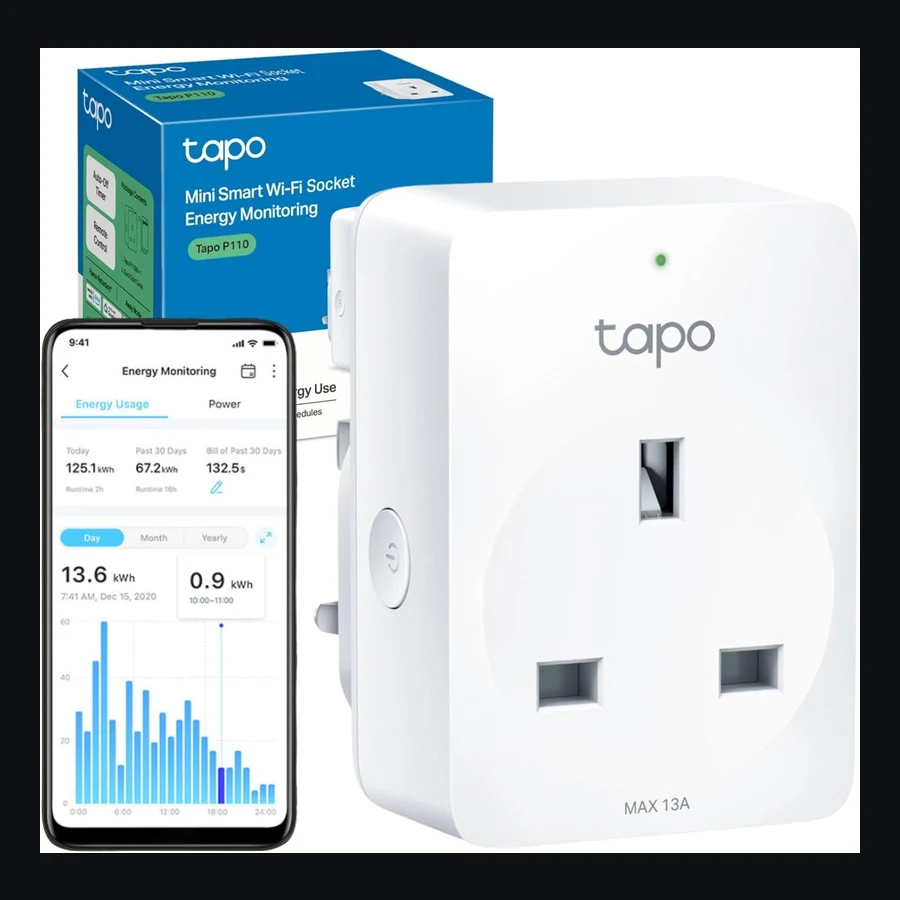
TP-Link Tapo P110
The renter-safe default UK smart plug with energy monitoring, buy a pack, not a hub.
Tapo P110, Eve Energy, Meross, Hive & Amazon Compared Honestly
The best smart plug UK buyers can get in August 2026. Tapo P110 vs Eve Energy vs Meross vs Hive vs Amazon Smart Plug compared on price, energy monitoring, Apple Home, Matter and hub lock-in.
The renter-safe default UK smart plug with energy monitoring, buy a pack, not a hub.

For most UK households in August 2026, the TP-Link Tapo P110 is the smart plug to buy: it monitors energy use, works with Alexa and Google without a hub, and costs around £12 for one or £32 for a four-pack. If you run an Apple Home setup, the Eve Energy (Matter) is the more reliable, privacy-focused pick at around £40. The Meross MSS305 Matter plug undercuts both at closer to £15 and pairs well with Home Assistant. Choose the Hive Active Plug only if you already own a Hive hub, and skip the Amazon Smart Plug unless you want Alexa-only control and do not care about energy monitoring.
Smart plugs are among the cheapest upgrades in the smart home, which is exactly why they are so easy to get wrong. The headline price you see on Amazon often hides the real cost of ecosystem lock-in, hub requirements, and (with some brands) the total you pay across a multi-pack.
Here is what the five best-selling options in the UK cost in August 2026:
| Plug | Single-plug price | Per-plug multi-pack price | Hub required? | Energy monitoring? |
|---|---|---|---|---|
| TP-Link Tapo P110 | ~£12 | ~£8 (4-pack at ~£32) | No | Yes |
| Meross MSS305 Matter | ~£15 | ~£12 (2-pack at ~£25) | No | Yes |
| Amazon Smart Plug | ~£20 | ~£15 (2-pack deal) | No | No |
| Hive Active Plug | ~£39 | ~£13 (triple pack, but you still need the hub) | Yes (Hive Hub) | No |
| Eve Energy (Matter) | ~£40 | ~£35 (2-pack at Apple) | No (Thread border router) | Yes |
Two numbers matter here. First, the Tapo P110 four-pack at ~£32 works out at £8 per plug — that is the lowest genuine cost per socket among the five, and it is why it dominates Amazon’s best-seller lists with 3,000+ reviews. Second, the Eve Energy at ~£40 is the most expensive single plug here, so you are paying a clear premium for Apple Home reliability and Thread. If budget is your only concern, Meross — not Tapo — is the second cheapest energy-monitoring option.
One trap worth flagging: multi-pack pricing looks good until you factor in a hub. The Hive Active Plug triple pack is about £39, but it only works after you have bought a Hive Hub (~£90). That makes the true entry cost closer to £130, which most people do not realise until checkout. Always add the hub to the total before comparing against hub-free plugs.
Every smart plug on this list has a real flaw, and the reviews on Reddit and Amazon are full of stories from people who bought the wrong one. Here is what you need to know before you order.
The single most common complaint across Tapo, Meross, Amazon and Hive plugs is the same: they only connect to a 2.4 GHz network. If your router broadcasts a combined 5 GHz / 2.4 GHz network (most UK routers do by default), the plug will fail the last step of setup every single time. The fix is to split the bands in your router settings or temporarily disable 5 GHz during pairing. This is mentioned repeatedly in HomeKit and Home Assistant threads, and it catches more first-time buyers than any other issue.
Reddit users on r/UKFrugal have reported that some TP-Link energy-monitoring plugs (the Kasa and Tapo ranges share the same internals) develop a fault after a year or so of continuous use — the energy-readout drifts or the plug drops offline until it is power-cycled. TP-Link’s own community forum also threads questions about energy-monitoring accuracy on the P110. It is not universal, and TP-Link’s warranty covers it, but it is worth knowing because these plugs are often left permanently behind appliances where a fault is hard to spot. There is also a separate gotcha: on the newer Matter-enabled P110M, energy monitoring is not available while paired in Matter mode — you only get it through the Tapo app.
The Eve plug is the most expensive option here at around £40, and its large, rounded UK body is noticeably bulkier than the compact Tapo and Meross plugs — it can block a neighbouring socket in a double gang. Reviews from linkdhome and MatterAlpha both flag the form factor. There are also scattered reports on r/HomeKit of the Matter version showing “No Response” in Apple Home for the first 24–48 hours until the Thread network settles. It settles, but an impatient buyer may think the plug is broken.
The Hive Active Plug is a good plug trapped inside an expensive ecosystem. It needs a Hive Hub, which most people already have if they run Hive heating — but if you do not, the total cost is prohibitive for a single socket. It also offers no energy monitoring, which is a notable omission at £39, and several reviewers on Trustpilot mention ongoing concern about Hive’s paid subscription push for some of its automation features. If you are not already a Hive household, there is little reason to start here.
The Amazon Smart Plug is the simplest plug on this list, and that is both its strength and its weakness. TechRadar and PCMag both note it has no energy monitoring at all, which rules it out if you want to track standby draw and cut your bill. It is also locked to Alexa — it does not work with Google Home, HomeKit or SmartThings, so if you ever change ecosystems the plugs become paperweights. Fine as a cheap ecosystem-companion, not as a standalone purchase.
If you plug in only a table lamp you switch by hand, a £12 smart plug is wasted money. If you have a mesh wi-fi system that broadcasts a single combined band and you do not want to touch router settings, expect a frustrating setup. And if you want to track how much your electric heater or washing machine draws, never buy a plug without energy monitoring — the Amazon Smart Plug and Hive plug will simply not give you that data.
| Feature | Tapo P110 | Meross MSS305 | Amazon Smart Plug | Hive Active Plug | Eve Energy (Matter) |
|---|---|---|---|---|---|
| UK price (single) | ~£12 | ~£15 | ~£20 | ~£39 | ~£40 |
| Energy monitoring | Yes | Yes | No | No | Yes |
| Works with Alexa | Yes | Yes | Yes | Yes | Yes |
| Works with Google Home | Yes | Yes | No | Yes | Yes |
| Works with Apple Home (HomeKit) | No | Yes | No | No | Yes |
| Works with Home Assistant | Local/cloud | Yes (local) | No | Via hub | Yes (Thread) |
| Hub required | No | No | No | Hive Hub | No (Thread router) |
| Matter / Thread | Matter (P110M) | Matter | No | No | Matter + Thread |
| Max load | 13 A / 2.9 kW | 13 A / 2.9 kW | 13 A | 13 A | 13 A |
| Physical size | Compact | Compact | Compact | Bulkier | Bulkiest |
Read across the table and the pattern is obvious. The Tapo P110 wins on price, energy monitoring and Hub-free simplicity. The Eve Energy wins for Apple Home reliability and Thread, but at more than three times the Tapo’s price. Meross is the value Matter option that still talks to Home Assistant locally. The two plugs with no energy row — Amazon and Hive — simply cannot compete for anyone who wants to cut their electric bill.
Buy if: you want energy monitoring, Alexa or Google voice control, and the lowest cost per plug — especially if you are wiring up whole rooms of lamps and chargers with the four-pack. Avoid if: you run Apple Home (no HomeKit), you need local control inside Home Assistant without any cloud, or you are put off by reports of the energy-readout fault developing after a year.
View the Tapo P110 on Amazon · Find the Tapo P110 on eBay
Buy if: you live in HomeKit and want a plug that will keep working over Thread with no cloud dependency, and you value privacy (Eve states it tracks no user data). Avoid if: you are on a budget, you have limited wall space (it is bulky), or you do not use Apple Home — you would be paying the Apple premium for no reason.
View the Eve Energy on Amazon · Find the Eve Energy on eBay
Buy if: you want Matter support and energy monitoring at a mid-range price, or you run Home Assistant and want local control. Avoid if: you are sensitive to setup friction — like all these plugs it is 2.4 GHz only, and some HomeKit users on Reddit report connectivity frustration (mostly with the older non-Matter models) that requires a few pairing retries.
View the Meross MSS305 on Amazon · Find the Meross MSS305 on eBay
Buy if: you already have a Hive Hub and heating system, and you want plugs that sit neatly inside the Hive app for whole-home routines. Avoid if: you are starting from scratch — the hub cost and the lack of energy monitoring make it poor value next to hub-free alternatives.
View the Hive Active Plug on Amazon · Find the Hive Active Plug on eBay
Buy if: you are deep in the Alexa/Echo ecosystem and want the lowest-friction plug for lamps and fans, with zero interest in energy data. Avoid if: you want to track your bill, or you might ever switch to Google Home or HomeKit — this plug cannot move with you.
View the Amazon Smart Plug on Amazon · Find the Amazon Smart Plug on eBay
For the vast majority of UK buyers in August 2026, the winner is the TP-Link Tapo P110. It is the cheapest per socket (about £8 in a four-pack), it monitors energy accurately enough to spot standby vampires, it needs no hub, and it works with both Alexa and Google. Its two real weaknesses — no HomeKit, and a reported energy-readout fault on some units after long service — are minor against the price and breadth of 3,000+ Amazon reviews.
If you are a committed Apple Home user, ignore the budget argument and buy the Eve Energy (Matter). Thread reliability and zero-cloud privacy justify the £40 price for a plug that will still be running in five years. And if you want Matter on a budget or run Home Assistant, the Meross MSS305 is the sensible middle ground.
Skip the Amazon Smart Plug and the Hive Active Plug for energy-conscious buyers — neither gives you the consumption data that makes a smart plug worth owning in the first place.
Only plugs with energy monitoring give you the data to actually find savings. By showing which appliances draw power on standby, a Tapo P110 or Eve Energy lets you switch them off remotely and measure the drop. The plug itself uses barely any power — typically under 1 W on standby — so the saving comes from the appliances you switch, not the plug.
Wi-Fi plugs (Tapo, Amazon) connect directly to your router and need no hub, but only work on 2.4 GHz. Thread plugs (Eve) form a low-power mesh and respond faster, but need a Thread border router such as an Apple TV or HomePod Mini. Matter is a universal standard that lets plugs work across Alexa, Google and Apple at once. Most UK buyers just want Wi-Fi simplicity — Matter only matters if you mix ecosystems.
None of these five indoor plugs is IP-rated for outdoor use — for a garden or garage you need a dedicated outdoor smart plug. On extension leads, keep the total load under the plug’s 13 A / ~2.9 kW limit and avoid daisy-chaining high-draw heaters through a single plug, which several Amazon reviewers warn against.
Once schedules are saved on the plug, basic on/off timers from Tapo and Meross continue locally. But voice control and remote app access stop when your broadband drops, because they route through the cloud. Thread plugs like the Eve keep responding to local HomeKit automations, which is a real advantage for reliability.
The renter-safe default UK smart plug with energy monitoring — buy a pack, not a hub. Score is high for the job; it's still a budget plastic plug.
UK reviewers love price, Matter/app maturity, and monitoring. Themes: cloud dependence anxiety, occasional Wi-Fi drops on busy 2.4GHz, and plastics feel cheap (expected). Excellent uninstall story for renters.
| install | plug-in |
| hub_required | false |
| energy_monitoring | true |
TP-Link Tapo P110 is our pick (9/10) vs Eve Energy (Matter) at 8.5/10. The best smart plug UK buyers can get in August 2026. Tapo P110 vs Eve Energy vs Meross vs Hive vs Amazon Smart Plug compared on price, energy monitoring, Apple Home, Matter and hub lock-in.
Around £9 on Amazon UK at last check (14 August 2026). Confirm on the retailer — prices move.
Choose Eve Energy (Matter) if you prioritise value over the overall winner (about £39.95 UK). See the score breakdown and drawbacks in the article.
Performance 40%, value 25%, build 20%, ease of use 15% — out of 10. Rankings are never sold. Full detail on our methodology page.
New versus matchups, garage-gym / gaming-room kit alerts, and deal notes. One email a week.
One email per week. Confirmation page next. Unsubscribe any time. Privacy.
Prices checked via the Amazon Creators API and may since have changed. Affiliate disclosure · How we test