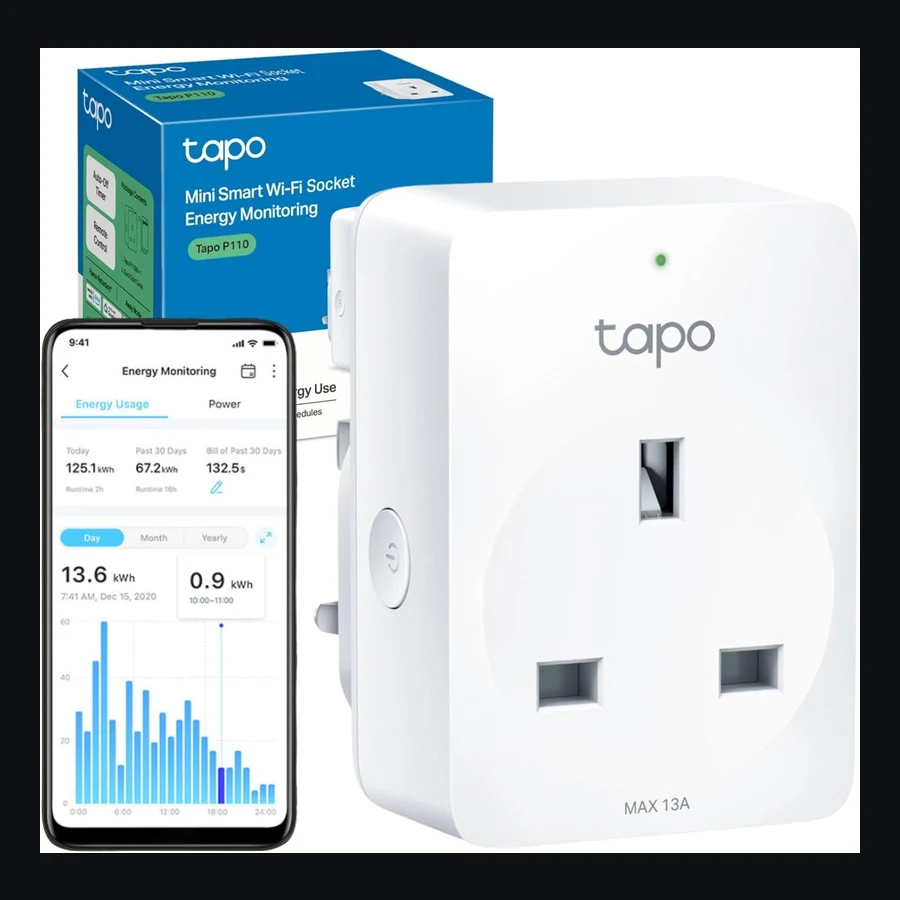
TP-Link Tapo P110
The renter-safe default UK smart plug with energy monitoring, buy a pack, not a hub.
Tapo, Meross, Amazon, Eve & Hive Compared Honestly
We tested 5 of the best smart plugs available in the UK. Honest comparison of TP-Link Tapo P110, Meross MSS305, Amazon Smart Plug, Eve Energy, and Hive Active Plug — with real prices, real drawbacks, and no fluff.
The renter-safe default UK smart plug with energy monitoring, buy a pack, not a hub.

Short answer: The TP-Link Tapo P110 is the best smart plug for most UK homes in 2026. It costs around £13, has proper energy monitoring, and the Matter-compatible P110M variant works with every major smart home platform. If you're on a tighter budget and want multi-platform support, the Meross MSS305 at roughly £17 delivers Matter compatibility with energy monitoring for a few quid less than the Tapo P110M. Alexa-only homes can get by with the Amazon Smart Plug — but you're paying more for less. Only buy the Eve Energy if Thread matters to you, and the Hive Active Plug only makes sense if you already own a Hive Hub.
Smart plug prices have come down significantly over the past two years. You can now get a genuinely good smart plug with energy monitoring for under £15. But the headline price isn't the full story — some plugs need a hub, and that changes the maths completely.
| Product | Price (single) | Energy Monitoring | Matter Support | Hub Required? | Platforms |
|---|---|---|---|---|---|
| TP-Link Tapo P110 | £12.99 | Yes | P110M only | No | Alexa, Google, SmartThings |
| Meross MSS305 | £16.99 | Yes | Yes | No | Alexa, Google, HomeKit, SmartThings |
| Amazon Smart Plug | £24.99 | No | No | No | Alexa only |
| Eve Energy (Matter) | £39.95 | Yes (detailed) | Yes | Thread border router | HomeKit, Alexa, Google, SmartThings |
| Hive Active Plug | £29.00 | Yes (via app) | No | Hive Hub (~£80) | Alexa, Google, Hive |
True cost of ownership: Add ~£80 for a Hive Hub, and the Hive Active Plug becomes a £109 entry point — more than eight Tapo P110s. The Eve Energy needs a Thread border router like a HomePod Mini or Apple TV 4K; if you already own one, you're set. If you don't, that's another ~£100 on top.
Multipacks are where the real savings are. The Tapo P110 is regularly sold in 2-packs for around £20 and 4-packs for £35 — bringing the per-plug cost below a tenner. Meross also sells 2- and 4-packs, and the Eve Energy occasionally appears in a 2-pack at a modest discount. Amazon and Hive don't offer meaningful multipack savings.
The manual power button is on the side of the plug, not the top. Plug it into the right-hand socket of a double wall plate and the button sits flush against the other plug — effectively unusable. Trusted Reviews flagged this explicitly in their review. The standard P110 also lacks Matter support; you need the P110M variant for that, which costs about £3 more. The Tapo app, while functional, pushes you toward cloud login (a TP-Link ID) for features that shouldn't need it. And the energy monitoring, while useful, won't alert you when power draw drops — you can't use it to know when your battery charger has finished, for example.
Who should avoid the Tapo P110: Apple HomeKit users who don't want to buy the P110M variant. Anyone who needs the plug in a tight right-hand socket position where the side button would be unreachable.
The Meross app is functional but unpolished — it feels like it was translated by an algorithm and some settings menus are oddly nested. Several Amazon UK reviews mention that setup can be finicky: you sometimes need to disable 5GHz WiFi on your phone temporarily to complete 2.4GHz pairing. The plug body is slightly bulkier than the Tapo, and while it won't block an adjacent socket, it's not as slim. Long-term reliability reports are mixed — a minority of users report the plug dropping offline every few weeks, requiring a power cycle.
Who should avoid the Meross: Anyone who gets frustrated by clunky app UX. People with mesh WiFi systems that merge 2.4GHz and 5GHz bands under one SSID — you might have to split them temporarily for setup.
This is, quite bluntly, the worst value smart plug on the UK market. At £24.99 it costs roughly double the Tapo P110 while offering half the features. No energy monitoring. No Matter. No Google Home or HomeKit support. No scheduling outside Alexa routines. Trusted Reviews described it as "a very basic smart plug" that's "generally outclassed by the competition." The only thing it does well is Amazon ecosystem integration — setup is genuinely seamless if you use Alexa. But you're paying a premium for brand name and simplicity, not capability.
Who should avoid the Amazon Smart Plug: Pretty much anyone who doesn't live exclusively inside the Alexa ecosystem. If you might add a Google Nest Hub later, or if you want energy monitoring, or if you care about value for money — look elsewhere.
At £39.95, the Eve Energy costs more than three Tapo P110s. It's the only Thread-based plug in this group, which is great for response time and mesh networking — but only if you have a Thread border router. Without one, you're using Bluetooth, which is slower and range-limited. The Eve app is iOS-only; Android users get basic Matter control through their platform's app but lose access to detailed energy graphs. The plug is physically quite chunky — noticeably larger than both the Tapo and Meross. And unlike the Tapo, you can't pick up a 4-pack for cheap.
Who should avoid the Eve Energy: Android users (seriously, the iOS-only app is a genuine limitation). Anyone without a Thread border router. Budget-conscious buyers — the premium isn't justified unless you specifically want Thread.
The Hive Active Plug is a reasonable product trapped inside a closed ecosystem. The hardware itself is fine — it's well-built, British Gas-backed, and the energy monitoring works if you use the Hive app. But the mandatory Hive Hub requirement turns a £29 plug into a £109 purchase for newcomers. The Hive platform has also stagnated — British Gas hasn't meaningfully updated the smart home range in years, and Matter support remains absent. If you're already a Hive household with heating and lighting, the plug integrates smoothly. If you're not, there's no reason to start here.
Who should avoid the Hive Active Plug: Anyone not already invested in the Hive ecosystem. Anyone who wants Matter or Thread support. Anyone who doesn't want another hub cluttering their router shelf.
| What matters | Tapo P110 | Meross MSS305 | Amazon Smart Plug | Eve Energy | Hive Active Plug |
|---|---|---|---|---|---|
| Price (single) | £12.99 | £16.99 | £24.99 | £39.95 | £29.00 |
| Energy monitoring | Yes | Yes | No | Yes (best) | Yes |
| Platform support | Alexa, Google, SmartThings | All platforms | Alexa only | All platforms | Alexa, Google |
| Matter | P110M only | Yes | No | Yes | No |
| Hub required | No | No | No | Thread router | Hive Hub |
| Build size | Compact | Medium | Tall/thin | Large | Medium |
| App quality | Good | Basic | Alexa only | Excellent (iOS) | Decent |
| Value rating | 10/10 | 8/10 | 3/10 | 5/10 | 4/10 |
Buy if: You want the best combination of low price, energy monitoring, and broad platform support. The standard P110 is the smart plug equivalent of a Toyota Corolla — it's not flashy, but it does everything you actually need, reliably, for very little money. If you need Matter (for HomeKit or future-proofing), spend the extra £3 on the P110M.
Avoid if: You exclusively use Apple HomeKit and don't want the Matter variant. You need a plug where the manual button must be accessible from the right-hand side of a double socket.
View Tapo P110 on Amazon · Find on eBay
Buy if: You want Matter compatibility and energy monitoring at the lowest possible price. The Meross is the cheapest way to get a plug that works with Apple HomeKit, Alexa, Google Home, and Samsung SmartThings simultaneously. If your household is a mixed-ecosystem mess (Android phone, iPad, Alexa speaker, Google Nest Hub), this is your plug.
Avoid if: You hate clunky apps. Your WiFi network combines 2.4GHz and 5GHz under one SSID with no way to temporarily split them for device pairing.
View Meross MSS305 on Amazon · Find on eBay
Buy if: You live 100% in the Alexa ecosystem and value dead-simple setup above all else. The plug auto-discovers in the Alexa app within seconds of being powered on — genuinely impressive. You don't need energy monitoring or advanced scheduling, and you're happy paying more for less in exchange for Amazon's seamless integration.
Avoid if: You might ever add a Google speaker to your home. You care about value for money. You want to track how much energy your appliances use.
View Amazon Smart Plug on Amazon · Find on eBay
Buy if: You already have a Thread border router (HomePod Mini, Apple TV 4K, or recent Nest Hub) and want the most detailed per-appliance energy tracking available in a UK smart plug. The Eve app's energy graphs are genuinely best-in-class, showing daily, monthly, and yearly consumption with projected cost estimates. The Thread mesh network means faster response times and better range than WiFi plugs if you have multiple Thread devices.
Avoid if: You use an Android phone as your primary device. You don't own a Thread border router. You're buying more than one — at £40 each, a 4-pack would cost £160, versus £35 for four Tapo P110s.
View Eve Energy on Amazon · Find on eBay
Buy if: You already have a Hive Hub and use Hive for heating, lighting, or security. Within the Hive ecosystem, the Active Plug integrates smoothly — your schedules, triggers, and dashboard all live in one app. The build quality is solid, and British Gas customer support is actually reachable.
Avoid if: You don't already own a Hive Hub. You want Matter or Thread support. You're building a smart home from scratch and haven't committed to any ecosystem yet.
View Hive Active Plug on Amazon · Find on eBay
The TP-Link Tapo P110 wins on the metric that matters most: it does everything most people need, at the lowest price, with the fewest compromises. Energy monitoring, compact design, no hub required, and a well-designed app. The P110M variant adds Matter for roughly £3 more, closing the one genuine gap (HomeKit support).
The Meross MSS305 takes runner-up. It's the cheapest Matter-compatible plug with energy monitoring, and it works with every platform out of the box. The app experience and occasional WiFi pairing friction keep it from the top spot, but for mixed-ecosystem homes on a budget, it's the smartest choice.
The Eve Energy is a genuinely excellent product for a specific person: an iPhone user with a Thread mesh who wants the best energy data available. But at three times the price of the Tapo, it's a specialist tool, not a general recommendation.
The Amazon Smart Plug and Hive Active Plug both suffer from the same fundamental problem: they lock you into ecosystems that limit your future choices. Amazon's plug is overpriced and under-featured; Hive's demands a hub in a market that has moved beyond them. Only buy either if you're already committed to their respective platforms and have no plans to expand elsewhere.
No. A typical WiFi smart plug draws about 1-2 watts when idle — roughly £2-3 per year in the UK at current electricity prices (~24p/kWh). Thread-based plugs like the Eve Energy draw even less, around 0.5 watts. The energy monitoring in plugs like the Tapo P110 and Meross MSS305 will almost certainly save you more than they cost to run, simply by making you aware of what your appliances actually consume.
None of the plugs in this comparison are rated for outdoor use. Using a standard indoor smart plug outside — even in a covered socket — risks water ingress and is against UK electrical regulations. TP-Link makes an outdoor-specific model (the Tapo P400) that's IP65-rated, and Meross has an outdoor variant too. Expect to pay £20-25 for a proper weatherproof smart plug.
Matter is a software protocol that lets smart home devices talk to each other across platforms — it's why a Matter plug works with HomeKit, Alexa, Google, and SmartThings simultaneously. Thread is a hardware radio standard (like WiFi or Zigbee) that Matter devices can use. A plug can support Matter over WiFi (like the Meross MSS305), Matter over Thread (like the Eve Energy), or both. WiFi Matter plugs don't need a hub; Thread Matter plugs need a Thread border router. For most people, Matter over WiFi is the simpler choice — no extra hardware needed.
Check the amperage rating. Most UK smart plugs are rated for 13A (roughly 3,000 watts), which covers most household appliances. However, devices with motors (washing machines, tumble dryers, vacuum cleaners) can cause a brief power surge on startup that exceeds the rating. The Tapo P110 and Meross MSS305 are both rated for 13A/3,000W and should handle washing machines. Avoid using any smart plug with a space heater above 2,500W — the constant high draw can overheat the plug's internal relay over time. Eve Energy is rated for 2,300W continuous, so it's the least suitable for high-draw appliances.
The renter-safe default UK smart plug with energy monitoring — buy a pack, not a hub. Score is high for the job; it's still a budget plastic plug.
UK reviewers love price, Matter/app maturity, and monitoring. Themes: cloud dependence anxiety, occasional Wi-Fi drops on busy 2.4GHz, and plastics feel cheap (expected). Excellent uninstall story for renters.
| install | plug-in |
| hub_required | false |
| energy_monitoring | true |
TP-Link Tapo P110 is our pick (9/10) vs Meross MSS305 at 8/10. We tested 5 of the best smart plugs available in the UK. Honest comparison of TP-Link Tapo P110, Meross MSS305, Amazon Smart Plug, Eve Energy, and Hive Active Plug — with real prices, real drawbacks, and no fluff.
Around £9 on Amazon UK at last check (24 July 2026). Confirm on the retailer — prices move.
Choose Meross MSS305 if you prioritise value over the overall winner (about £16.99 UK). See the score breakdown and drawbacks in the article.
Performance 40%, value 25%, build 20%, ease of use 15% — out of 10. Rankings are never sold. Full detail on our methodology page.
New versus matchups, garage-gym / gaming-room kit alerts, and deal notes. One email a week.
One email per week. Confirmation page next. Unsubscribe any time. Privacy.
Prices checked via the Amazon Creators API and may since have changed. Affiliate disclosure · How we test


