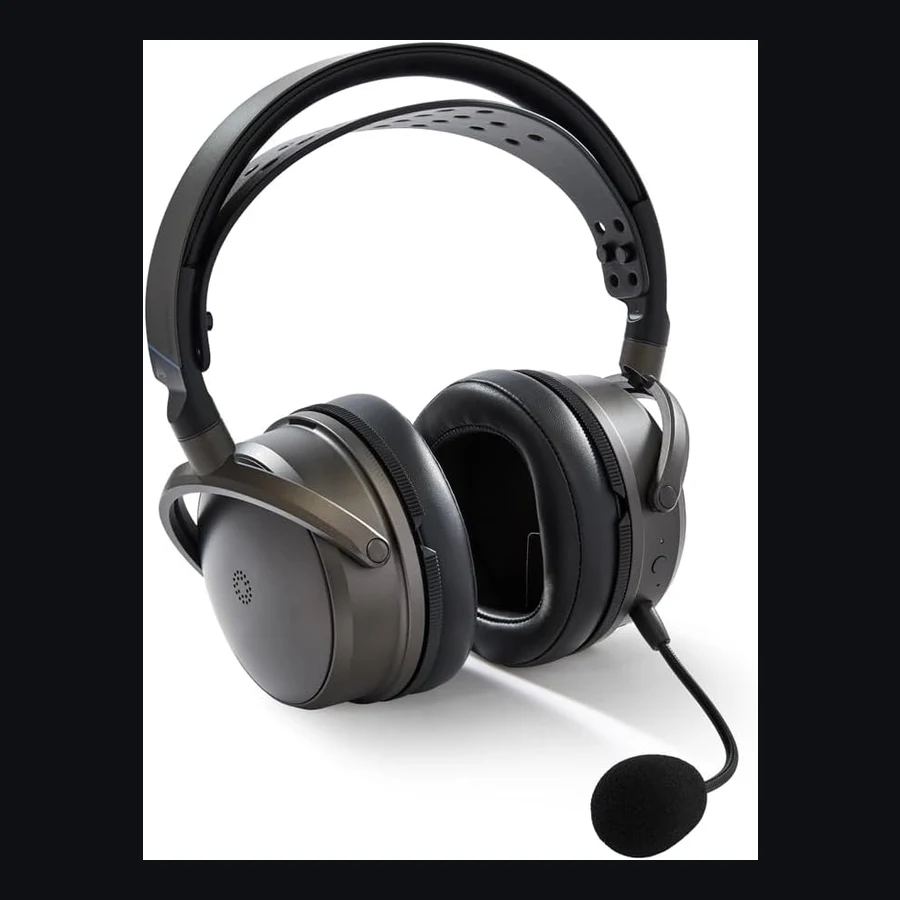
Audeze Maxwell
Buy for planar detail and battery bragging rights, only if you can handle the weight and the price.
Best Premium Wireless Gaming Headset?
Active noise cancellation vs planar magnetic drivers. Hot-swap batteries vs 80-hour battery life. Which 280+ pound wireless gaming headset sounds better?
Buy for planar detail and battery bragging rights, only if you can handle the weight and the price.

At 230-280 pounds, the SteelSeries Arctis Nova Pro Wireless and Audeze Maxwell represent the ceiling of wireless gaming audio. One uses active noise cancellation and a desktop DAC. The other uses planar magnetic drivers — technology normally found in 1,000-pound audiophile headphones. The choice depends on whether you care more about convenience or sound quality.
The Audeze Maxwell uses 90mm planar magnetic drivers — the same technology behind Audeze's studio headphones. Planar magnetic drivers move a thin diaphragm between magnets, producing faster transients and lower distortion than traditional dynamic drivers. In practice: footsteps in competitive shooters have sharper attack. Explosions have more defined low end without muddying the midrange. Music sounds closer to a wired audiophile headphone than any other wireless gaming headset.
The Arctis Nova Pro uses 40mm dynamic drivers tuned by SteelSeries' audio team. They sound good — clean, balanced, with slightly elevated bass for gaming impact. They do not sound like planar magnetics. Next to the Maxwell, the Nova Pro sounds competent but constrained. The Maxwell sounds expansive.
The Nova Pro Wireless has active noise cancellation. The Maxwell does not. If you game in a noisy environment — open-plan office, living room with a television — the Nova Pro's ANC is genuinely useful. If you game in a quiet room, it is irrelevant.
The Nova Pro uses hot-swappable batteries: one charges in the DAC while the other powers the headset. You never plug the headset in. The Maxwell has an 80-hour battery life with no hot-swap system. Both solutions work — the Nova Pro is more convenient during marathons, the Maxwell needs charging once a fortnight.
Buy Audeze Maxwell (280 pounds) for: the best wireless sound quality in gaming. Planar magnetic drivers are a genuine step up. Buy SteelSeries Arctis Nova Pro (230 pounds) for: ANC, hot-swap batteries, and the desktop DAC with simultaneous Bluetooth.
Buy for planar detail and battery bragging rights — only if you can handle the weight and the price. A 9 for sound, lower for neck comfort.
Audiophile-leaning gamers rave about detail and battery. Themes: heavy clamp, price, and mic not justifying the sticker alone. Overkill for casual Fortnite; fantastic for competitive + music.
| type | planar wireless |
| wireless | true |
| weight_class | heavy |
Audeze Maxwell is our pick (9.1/10) vs SteelSeries Arctis Nova Pro at 8.8/10. Active noise cancellation vs planar magnetic drivers. Hot-swap batteries vs 80-hour battery life. Which 280+ pound wireless gaming headset sounds better?
Around £339 on Amazon UK at last check (13 July 2026). Confirm on the retailer — prices move.
Choose SteelSeries Arctis Nova Pro if you prioritise value over the overall winner (about £229.99 UK). See the score breakdown and drawbacks in the article.
Performance 40%, value 25%, build 20%, ease of use 15% — out of 10. Rankings are never sold. Full detail on our methodology page.
New versus matchups, garage-gym / gaming-room kit alerts, and deal notes. One email a week.
One email per week. Confirmation page next. Unsubscribe any time. Privacy.
Prices checked via the Amazon Creators API and may since have changed. Affiliate disclosure · How we test