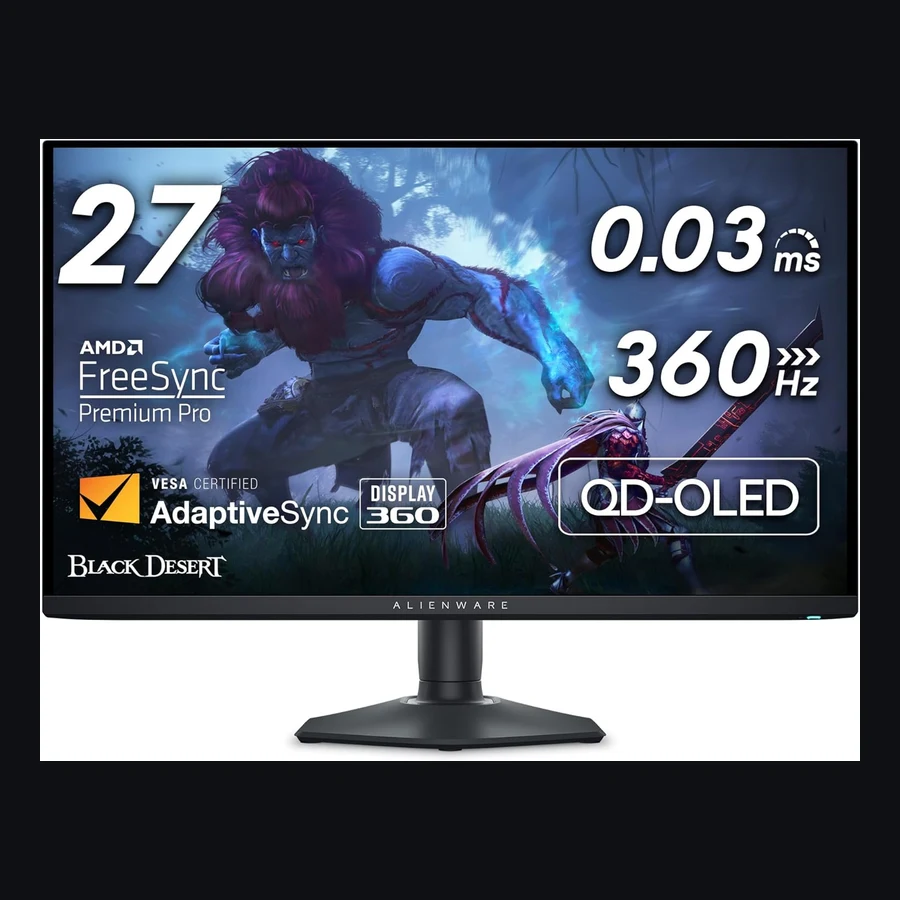
Alienware AW2725DF
Buy for fast 1440p QD-OLED / high-refresh gaming in a 27" footprint that fits UK desks, not if you need perfect text for 10-hour coding (OLED care still matters).
Best QD-OLED Gaming Monitor?
Samsung G80SD vs Dell Alienware AW2725DF. Both 27-inch 1440p QD-OLED at 360Hz. Which panel, stand, and warranty wins?
Buy for fast 1440p QD-OLED / high-refresh gaming in a 27" footprint that fits UK desks, not if you need perfect text for 10-hour coding (OLED care still matters).

Samsung makes the QD-OLED panels. Dell puts them in the Alienware AW2725DF. Samsung puts them in the Odyssey G8 G80SD. Both are 27 inches, 1440p, 360Hz. Both use the same underlying display technology. The differences are in the stand, the ports, and the warranty — and Alienware wins all three.
Both monitors use the Samsung Display QD-OLED panel — 2560 x 1440, 360Hz refresh, 0.03ms response time. Colour accuracy, contrast ratio, and motion clarity are indistinguishable. If you placed them side by side without the bezels, you could not tell which was which from image quality alone. This is the most commoditised monitor comparison in gaming — choose based on everything except the panel.
The Alienware AW2725DF has a compact hexagonal base that takes up roughly 220mm of desk depth. The Samsung Odyssey G8 has a wide V-shaped stand that requires nearly 300mm of depth — a significant footprint for smaller desks. The Alienware stand is also fully tool-less, snapping together in under two minutes. The Samsung requires a screwdriver.
Dell covers the AW2725DF with a 3-year warranty that explicitly includes OLED burn-in. Samsung covers the Odyssey G8 with a 2-year warranty that does not mention burn-in. For a monitor technology where organic degradation is a known characteristic, the warranty difference matters — especially if you use the monitor for work with static interface elements.
Buy Alienware AW2725DF (600 pounds) — same panel, better stand, better warranty. Buy Samsung Odyssey G8 (600-700 pounds) only if you need the built-in Smart TV apps or prefer Samsung's design.
Buy for fast 1440p QD-OLED / high-refresh gaming in a 27" footprint that fits UK desks — not if you need perfect text for 10-hour coding (OLED care still matters).
Review themes: outstanding motion clarity, HDR pop, and Alienware stand quality. Concerns: OLED burn-in anxiety for static HUDs, Windows text fringing for some eyes, and premium UK street price. Warranty/pixel policies matter — check Dell UK terms.
| panel | QD-OLED (check SKU) |
| size_in | 27 |
| refresh_hz | high (model-dependent) |
| resolution | 2560x1440 |
Alienware AW2725DF is our pick (9/10) vs Samsung Odyssey G8 G80SD at 8.6/10. Samsung G80SD vs Dell Alienware AW2725DF. Both 27-inch 1440p QD-OLED at 360Hz. Which panel, stand, and warranty wins?
Around £517.4 on Amazon UK at last check (13 July 2026). Confirm on the retailer — prices move.
Choose Samsung Odyssey G8 G80SD if you prioritise value over the overall winner (about £674.82 UK). See the score breakdown and drawbacks in the article.
Performance 40%, value 25%, build 20%, ease of use 15% — out of 10. Rankings are never sold. Full detail on our methodology page.
New versus matchups, garage-gym / gaming-room kit alerts, and deal notes. One email a week.
One email per week. Confirmation page next. Unsubscribe any time. Privacy.
Prices checked via the Amazon Creators API and may since have changed. Affiliate disclosure · How we test